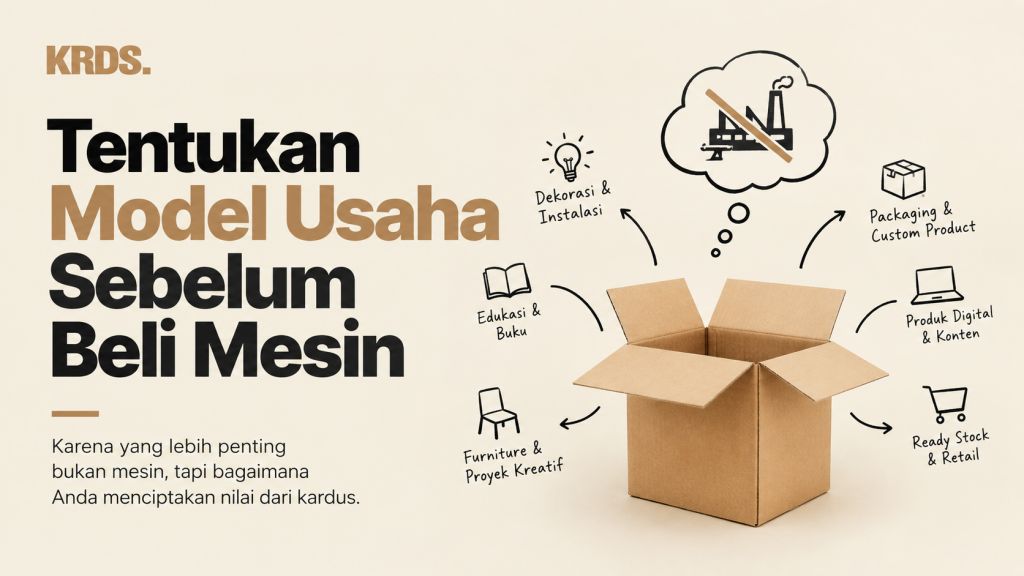
If you want to start a corrugated cardboard business, don't rush to buy a machine. Decide first: what exactly do you want to sell?
There is a rather interesting pattern when we look at several cardboard-based businesses that have survived for years. They all use cardboard as their main material. But if you look closely, the way they make money from cardboard turns out to be very different.
Some sell decoration and installation services. Some sell creative works and books. Some make furniture and installations. Some sell templates and digital products to the international market. And some simply sell ready-stock boxes. In other words, the cardboard may be the same. But the business models can be very different.
This is exactly where I think many people go wrong when they want to enter the cardboard industry. They look at machines first. “If I had a corrugator, I could produce my own boxes.” “If I had a cutting machine, I could make lots of products.” “If I had a printing machine, my business would surely be bigger.” Yet the first question that should come up is not: “What machine should I buy?”
But rather:
“What kind of cardboard business do I actually want to build?”
Cardboard Doesn't Have to Mean Becoming a Box Factory, This is something I think needs to be clarified from the start. Entering the cardboard industry does not automatically mean you must own a box-making machine. It doesn't even automatically mean you must own a factory. Cardboard is just a material. What matters far more is the value we want to build from that material.
Let's look at a few examples.
1. Bumi Kardus: Cardboard Becomes Decoration and Installations. One interesting example is Bumi Kardus, built by Baba, or Sanjaya. The origin story is actually not about machines at all. Baba used to work as a security guard. Then an activity came along that may have looked simple at first: building a Formula 1 car out of cardboard, at a very large size and with maximum detail. That work then went viral and was covered by various media outlets.
Bumi Kardus—the name comes from his son's name, Bumi. Today the business model is very different from just “making cardboard crafts”. Bumi Kardus is trusted with a range of needs such as backdrops, decorations, booths, and installations for various events. The cardboard is still cardboard.
But what the clients buy is actually not cardboard. Clients are buying:
ideas + design + creativity + craftsmanship + installation + experience.
And that is a huge difference. If we only think:
“I want a cardboard business.” we will probably think about machines. But if we think:
“I want to be a provider of cardboard-based decoration and installations.” then a machine is just one of the tools that may be needed later on.
2. Uci Widya: Cardboard Becomes Education
Another example is Uci Widya. It started from an activity very close to everyday life: making cardboard crafts for kids. From that activity it grew into creative works and education. She makes a variety of cardboard crafts, then writes and publishes books about cardboard crafts. Even now, her activities have grown into various educational programs, and she is a speaker at many events.
Once again, look at the business model. There is no requirement that a business like this must own its own cardboard production machine. Because what's being sold is not sheets of cardboard. What's being sold is:
knowledge + creativity + creative works + education + personal brand.
If from the start Uci had thought that entering the cardboard industry required owning a machine, the business path that formed might have been very different. Yet with the same material, someone can build a business based on knowledge and the creative industry.
3. Dusdukduk: Cardboard Becomes Furniture and Installations
Then there is Dusdukduk. It started from a university final project. They made furniture out of cardboard. The name “Dusdukduk” itself is closely tied to that origin story—it comes from the activity of making things to sit on out of cardboard.
From a final project, it grew into a brand. And today, the cardboard they use is not just for making chairs. Dusdukduk has grown into various products, installations, decorations, and creative projects. The scale of their projects can even be very large. When a large installation has to be built, what's really needed is not only material. It takes: design, engineering, production, labor, project management, installation, and even dismantling.
This means that the bigger the project, the clearer it becomes that machines are not the only important asset. At a certain point, the ability to manage projects and people may even matter far more than simply owning a machine.
4. Kraftstudio: Cardboard Becomes a Global Digital Product
The next example I find interesting is Kraftstudio, built by Mas Dian. It also started very simply. Making cardboard crafts. But what's interesting is the attention to detail. The work did not stop as a physical object. Templates of those works were sold on platforms like Etsy. Content was also created and published on YouTube.
Here the business model changes again. The material is still cardboard. But part of the economic value actually comes from digital products and distribution over the internet. A design can be made once, and then its template can be sold to buyers in many countries. So the market served is no longer limited to people near the workshop. This is an interesting example of how the skill of making things from cardboard can grow into a digital product with a global market. Four Businesses, Four Models
To simplify:
| Business | Starting Point | Model Built |
|---|---|---|
| Bumi Kardus | Cardboard F1 car | Decoration, booths & installations |
| Uci Widya | Cardboard crafts for kids | Education, books & personal brand |
| Dusdukduk | Cardboard furniture final project | Furniture, installations & creative projects |
| Kraftstudio | Detailed cardboard crafts | Templates, content & digital products |
What's interesting is not just each individual story. What's interesting is what they have in common. They did not have to start by becoming a box factory. They found ways to create added value from cardboard.
I Started Without a Machine Myself I had the same experience when I built my cardboard business. I created Pondok Kardus, Tangerang Kardus, Cibubur Kardus, and Bandung Kardus. And to this day, those stores are still running.
But when I started, I didn't buy a box-making machine. I did something much simpler: I bought boxes from a factory, then resold them at retail as ready stock. Why?
Because at the time my question was not: “How can I produce cardboard boxes?”
But: “How can I sell cardboard boxes?” These are two very different questions.
If it turns out ready-stock products sell, that means there is a market. If demand keeps growing, we can start thinking about efficiency. If volume gets high enough, it may start to make sense to think about producing in-house. Only then do machines become part of the conversation.
Not the other way around. Machines Are Important, But Not Always the First Step I'm not saying machines don't matter. In the cardboard industry, machines can be a very important asset. Machines can improve: production capacity, speed, consistency, labor efficiency, quality, and the ability to take on certain kinds of work. But a machine is a tool for running a business model. It is not the business model itself. It's like someone who wants to open a restaurant.
The first thing on their mind shouldn't be: “I have to buy an oven that costs this much. ”When they don't yet know: what food they'll sell, who will buy it, what the selling price is, what the margin is, how many orders there will be, and how to get customers. An oven is certainly important. But an oven doesn't automatically give a restaurant customers. The same goes for a cardboard machine.
A machine doesn't automatically create a market. Before Buying a Machine, Answer These 5 Questions. If you are considering entering the cardboard business, I think there are a few questions far more important to answer first.
1. What do I want to sell? Is it: ready-stock boxes? custom boxes? packaging? production services? furniture? decoration? booths? installations? toys? crafts? education? templates? digital products?
The cardboard is the same. But the business is different.
2. Who is my target market? Do you want to sell to: B2C? People who are moving house. SMEs? Online shop owners who need packaging. Companies? Who need packaging in large quantities. Event organizers? Who need booths and decoration. Schools? Who need craft materials. Architects or interior designers? Who need material for prototypes or installations. Or even: the global market? Like the digital product example. The target market will determine the business model.
3. What problem do I solve? This is a question that is often forgotten. Don't just say: “I sell cardboard boxes.” Try changing it to: “I help people who are moving get ready-to-use boxes.” or: “I help brands create custom packaging.” or: “I help event organizers build eco-friendly installations.” or: “I sell cardboard craft templates that people can make themselves.” Same product. Different problem solved. And when the problem is different, the price and the way of selling can be different too.
4. How do I make money? This is what's called a business model. Does the money come from: margins on box sales, production services, design services, projects, installations, royalties, books, classes, sponsorships, digital products, marketplaces, or a combination of several sources? Before buying a machine, we should already have a picture of those sources of income.
5. When do I really need a machine? Now, this is the question about machines. Once the business model has taken shape, only then can we calculate: “Is it cheaper to buy a machine or keep using a factory's services?” “What minimum volume makes the machine make sense?” “How long is the payback period?” “Will the machine be used every day?” “Do I already have enough orders?” “Is my problem really production capacity?” Because the main problem may turn out not to be capacity.
The problem may actually be that you don't have a market yet. Don't Get Trapped Buying Capacity Before You Have a Market I think this is one of the biggest risks when starting a manufacturing-based business. We buy a machine because it looks cool. We see other people owning machines. We see big production capacity.
Then the feeling comes: “If I had this machine, I could make lots of products.” True. But the next question is: “Who is going to buy those products?” Because a machine can produce capacity. But capacity does not mean sales. Having a machine with a capacity of 10,000 boxes per day doesn't mean much if the orders coming in are only 500 boxes. On the other hand, a business that doesn't own a machine yet but has steady orders can use another factory first. The gap between the purchase price from the factory and the selling price becomes room to build the business. When volume is large enough, only then does the decision to invest in a machine become more rational. Start from the Model, Not from the Machine
If I had to boil this whole article down to one sentence, it would probably be this: Don't buy a machine to look for a business model. Find the business model first, then use the machine to strengthen it. Because the cardboard industry is broad. You don't have to be a corrugated box manufacturer. You can be a distributor. You can be a retailer. You can be a converter. You can be a packaging specialist. You can be a decorator. You can be a furniture maker. You can be an installation provider. You can be an educator. You can create digital products. You can be a content creator. Or even combine several of those models. Cardboard is just the medium.
What determines the business is how you create value from that cardboard. So, If You Want to Start a Cardboard Business, Where Do You Start? I think the order should actually look like this:
1. Define your target market.
Who do you want to serve?
↓
2. Find the problem.
What do they need?
↓
3. Define the product or service.
What will you offer?
↓
4. Define the business model.
Where does the money come from?
↓
5. Test the market.
Is anyone willing to pay?
↓
6. Build the production system.
You can start with suppliers or other factories.
↓
7. Calculate capacity.
What is the real production need?
↓
8. Only then consider a machine.
Will the machine make the business more efficient and more profitable?
The order becomes far more sensible. Machines Can Be Bought Later. The Business Model Can't. I actually want to invite aspiring cardboard entrepreneurs to look at this industry from a broader perspective. Don't see cardboard only as a product that has to be produced. See cardboard as a material that can produce many business models.
Bumi Kardus shows that cardboard can become installations and decoration.
Uci Widya shows that cardboard can become an educational medium.
Dusdukduk shows that cardboard can become furniture and large-scale installation projects.
Kraftstudio shows that works made of cardboard can even be translated into digital products and reach a global market.
And my own experience shows that a cardboard business can even be started in a very simple way:
take goods from the factory, resell them to the people who need them.
No machines. No factory. But there was a product, a market, and transactions. Because in the end, what makes a business last is not how many machines it owns. But rather:
how clear the business model is, how precise the target market is, and how much value it manages to give to customers. So if today you're thinking: “I want to start a cardboard business. What machine should I buy?”
Maybe the question needs to change to: “What kind of cardboard business do I want to build?” Once you've found the answer, then we can talk about machines.
Because machines should follow the business.
Not the business being forced to follow the machine.
Marwantalk.com/krds