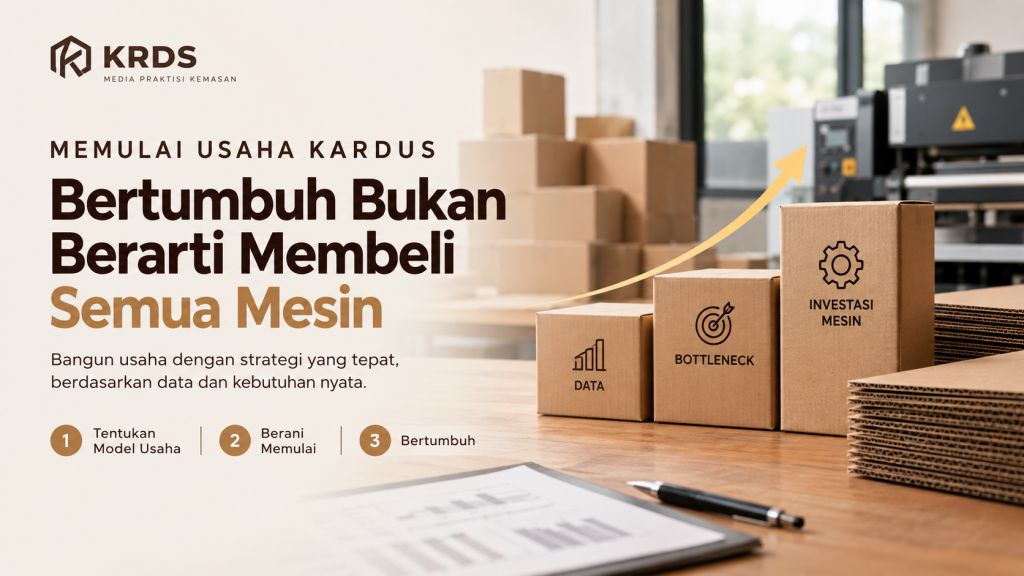
In the previous article, we discussed how starting a corrugated box business doesn't mean you have to buy machines first. There are three simple stages that I think matter more:
- Define the business model
- Dare to start
- Grow
We've already covered the first two stages. Now we move on to the third: growing. And this is where mistakes often happen. When the business starts getting orders, owners begin to think: "It's time to buy a machine." But the better question isn't: "Which machine should I buy?" It is: "Which part of the production process is holding back my business growth the most?"
Because growing doesn't mean making the factory more complete. Growing means improving the business's capability step by step based on real needs. You Don't Need to Buy Every Machine. When you're just starting, you can work with vendors or other factories to handle the production processes you don't have machines for yet.
For example, say we get a corrugated box order with certain specifications. We don't need to own every machine to fulfill it. Some processes can be done in-house, while the rest we hand over to vendors. This way, we are actually doing something very important:
Production management. We learn to manage: incoming orders, product specifications, material requirements, the production process, vendors, production costs, turnaround time, quality control, delivery, and customer complaints. Interestingly, this is where we start to gather data.
And this data becomes the basis for when we want to invest in buying a machine. The Machine You Buy Should Follow the Data. I have seen several friends who, as soon as they started to grow, bought the machine that was considered essential for a corrugated box business.
The problem is that a machine considered essential isn't necessarily the one your business needs most. Every business has different needs. For example, after a few months of production, it may turn out that most of what we pay vendors goes to the slitter or cutting process.
Then there is a strong reason to start considering an investment in a slitter machine. But the opposite could also happen. From the order data, it may turn out that the biggest cost comes from the die-cutting (pond) process, for example to create certain patterns or shapes. In that case a butterfly die-cutting machine could be the more relevant investment. There is no one-size-fits-all answer. The right machine for one business isn't necessarily the right machine for another. It all depends on: order type, order volume, product specifications, vendor costs, production capacity, turnaround time, and the business's growth target. So don't buy a machine just because: "The factory next door has this machine."
Or:
"They say you must have this machine if you want a corrugated box factory." The more important question is: "Based on my own business, which machine makes the most sense to buy right now?" The answer has to come from data, not assumptions.
Producing Without Your Own Machines Can Actually Be a Learning Process
When we haven't yet handled the whole production process ourselves, it may feel like we have a limitation. But there is actually an advantage we often don't notice. We are forced to understand the production flow. We know which processes need a vendor. We know how much it costs. We know how long the process takes. We know which vendors can meet our quality and deadlines. And most importantly: we start to see which part consumes the most cost.
Imagine we have 100 orders. After recording and analyzing them, it turns out: 40% of production cost goes to process A, 25% to process B, 15% to process C, and the rest to other processes.
Then when we want to invest, we have a basis for setting priorities. No longer: "I want to own a machine." But rather: "I want to reduce costs and increase capacity in the process that burdens production the most." Those are two different ways of thinking. Growth Begins When We Find the Bottleneck
After we finally buy our first machine, the journey isn't over. This is exactly where the next growth phase begins. Because once one bottleneck is solved, another one usually appears. For example, the slitter process used to be the constant bottleneck. Then we bought a slitter machine. The slitter process became faster. But then a new problem emerged. The slitter machine can now produce many sheets, but the next process can't keep up with that capacity. In the end, the bottleneck moves.
This is what's interesting about business growth. We don't always know from the start which machine we will need next. We find out after running the business. A Bottleneck Is a Clue for Growth. A bottleneck isn't always something to be feared. In a production context, a bottleneck can actually be a clue to the next investment.
For example:
Orders increase → capacity of process A isn't enough → queues form → deadlines start to slip → we look for a solution.
The solution could be: adding shifts, adding labor, improving SOPs, finding alternative vendors, doing maintenance, improving the layout, or buying a machine. This means buying a machine is only one of the solutions.
Let's not turn every production problem straight into: "So we have to buy a machine." Not necessarily. The problem might lie in production management. It might be a lack of labor capacity. It might be an inefficient production layout. It might be poor order scheduling. It might be that the chosen vendor isn't the right fit. Or it really is time to invest in a machine. We can only know this when our production process is managed and recorded properly. Grow Step by Step. I think growing a corrugated box business makes more sense when done like this:
Start → Get Orders → Manage Production → Record Data → Find the Bottleneck → Look for a Solution → Invest → Increase Capacity → Find the Next Bottleneck.
Not: Buy Machines → Then Look for Orders.
The difference is huge. In the first pattern, the business decides the machine. In the second, the machine decides the business. Yet a machine should be a tool to help the business grow, not the goal of the business itself. Don't Chase a Fully Equipped Factory
Maybe one day we will indeed have a fully equipped set of machines. But in my view, that is the result of the journey, not a requirement for starting. We can start with a simple business model. We can use vendors. We can learn to manage production. We can collect data.
We can find out which process consumes the most cost. Then we start buying the first machine. After that, we find the next bottleneck. Then we fix it. Then the business grows again. And the process keeps repeating. That is growth. Not buying all the machines at the beginning. But buying the machines the business actually needs, at the right time.
Conclusion
If we want to start a corrugated box business, let's not use how complete our machines are as the measure of readiness. What matters more is our ability to get orders, manage production, maintain quality, meet deadlines, and understand the numbers inside the business. Because once the business is running, the data starts to speak. From that data we can learn:
- What is the most expensive?
- What is the slowest?
- What most often becomes a bottleneck?
- What do we do most often?
- And what is most worth investing in?
That's what makes the decision to buy a machine more rational. So, growing doesn't mean buying as many machines as possible. Growing is the ability to increase business capacity based on real problems we find in the field. And maybe it is precisely from those bottlenecks that we learn what to build next.