In my previous article, I talked about four founders who started corrugated box businesses without owning a machine right away: Bumi Kardus, Kraftstudio, Uci Widya, and Dusdukduk.
Their stories point to something interesting. Starting a corrugated box business turns out not to begin with buying a machine. Before you get to owning machines and building your own factory, there are several things you need to learn first.
So the question is:
If it doesn't start with buying a machine, where does it start?
In my view, there are a few stages to go through.
1. Define Your Business Model
Before we talk about machines, we first need to understand what kind of corrugated box business we want to run. A corrugated box business doesn't only mean owning a factory and producing boxes yourself. There are many possible business models.
You can be a seller or distributor, you can focus on finding customers and have a vendor do the production, you can be the link between customers and factories, or you can eventually grow into a producer with your own machines. In the early stage, what matters most is not how many assets we own.
It is this:
“Where exactly do I want to play in the corrugated box business?”
The answer to that question will determine the next step.
2. Dare to Start
Once we know the business model we want to run, the next stage is the simplest and, at the same time, the hardest:
start.
Many people who want to start a corrugated box business think:
“Once I have a machine, then I can start.”
In fact, it can work the other way around. We can begin by learning to get orders first, then find a vendor who can handle the production. This is where we begin to learn that running a corrugated box business is not only about how to make boxes.
There is a lot of other knowledge to master. Learn to Get Orders
Before owning a machine, we can learn one very important thing:
how to get customers.
Because in the end, a machine only becomes an asset that makes money when orders come in. Learning to find customers, understand their needs, prepare quotations, calculate prices, follow up, and win repeat orders are all very important skills.
Even once you have your own factory, the ability to get orders remains one of the most important parts of the business. Learn Production Management Without Your Own Machines. This is the part I find most interesting. Not having a machine yet doesn't mean we can't learn about production.
We can work with several vendors or factories to fulfill incoming orders.
From here we start to learn: how to choose vendors, how to set production prices, how to manage deadlines, how to divide the work, how to do QC, how to make sure specifications match the order, how to handle revisions or production mistakes, and how to make sure goods reach the customer on time.
In other words, we learn to manage production before we have production of our own. This matters. Because when we eventually own our machines, we will at least already understand how an order has to run from start to finish. Learn About Your Fleet. There is one thing that is often overlooked when we talk about the corrugated box business:
distribution.
Corrugated boxes are relatively large and take up space. That means shipping costs can be a fairly significant component of an order.
I have a story from a friend who now owns a fairly large factory with more than 40 employees. Interestingly, when he was just getting started, he didn't buy all the machines right away. One of the first decisions he made was to buy a fleet.
Why?
Because he saw that the cost of distributing corrugated boxes was considerable. By owning his own fleet, he could manage distribution costs and control more easily. This is one example showing that in business, the first asset you buy doesn't always have to be a production machine. Sometimes another asset has a bigger impact on business efficiency at a given stage.
Learn About Warehousing
Besides production and distribution, there is one more thing to understand:
storage. Corrugated boxes need space.
And the more orders come in, the more space is needed to store both materials and finished goods.
This is where we start to learn about:
warehouse capacity, placement of goods, the flow of goods in and out, material stock, storage time, and how to keep the warehouse from becoming too full. It looks simple. But as business volume grows, warehouse issues can become big issues. That is why understanding storage management from the start will help a lot when the business begins to grow.
Make the Most of Your Network
Another thing that is just as important is your network. When you don't own machines yet, your network of vendors becomes very important. We don't have to master everything ourselves. In fact, early on we can build relationships with several vendors who have different production capabilities.
For example, vendor A is strong in one type of production, vendor B is capable in another, and vendor C may have larger capacity. From there we learn how to divide the work properly.
The friend I mentioned earlier also followed this pattern when he was starting out. He didn't do everything himself right away. Incoming orders were managed, then the work was divided among several different vendors. What he learned was not only how to make the product, but how to run the whole process so that it stayed efficient and met deadlines. And it was through that process that his business capability was formed.
So, What Are You Actually Building at the Start?
If you look closely, in the early stage we may not have many machines. But we are actually building something far more important:
the ability to run a business.
We learn:
getting orders → calculating → finding vendors → organizing production → doing QC → organizing the warehouse → organizing the fleet → delivering goods → taking care of customers → getting repeat orders.
All of these processes become very valuable experience. Because when the business gets bigger, the question is no longer simply:
“How do I make corrugated boxes?”
But rather:
“How do I manage a system that can produce and deliver thousands, even tens of thousands of boxes consistently?”
And that capability can't be bought together with a machine. It has to be built through experience. The Machines Will Come at the Right Time. Maybe in the end we will indeed need our own machines.
Maybe one day we will even need many machines, a bigger warehouse, more vehicles, and more employees. But everything has its own time. Let's not buy machines too soon, while there are no orders yet, the production system isn't understood yet, and the ability to run a business hasn't been formed yet. Because a machine is not the business. A machine is only one part of the business.
What keeps a business running is how we get orders, manage production, organize distribution, maintain quality, and build relationships with customers.
From Daring to Start, to Growing
To put it simply, the journey of starting a corrugated box business looks roughly like this:
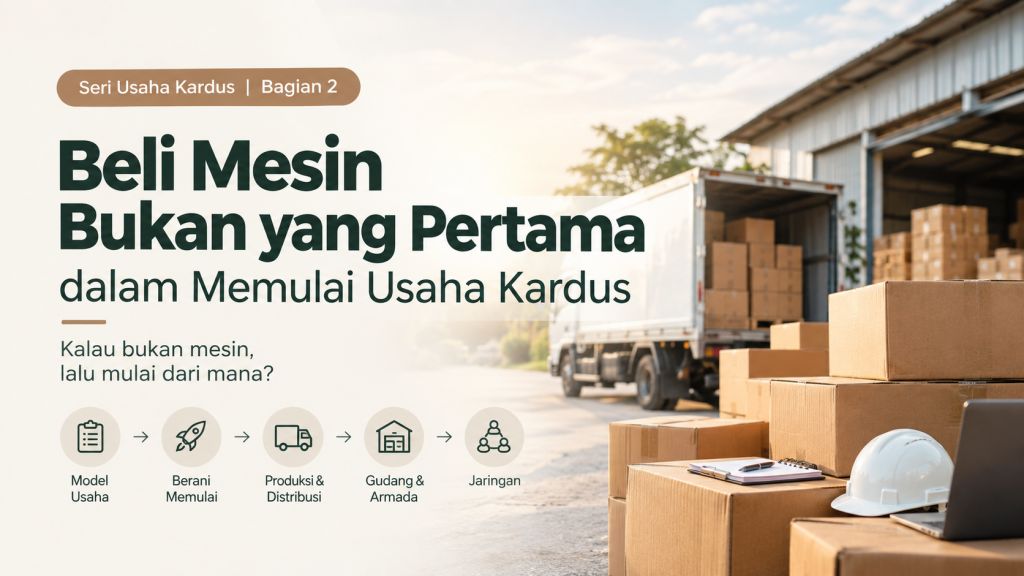
Define the business model → Dare to start → Learn to get orders → Learn to manage production → Understand distribution → Understand the warehouse → Make the most of your network → Then grow.
And once this “dare to start” stage has been passed, the journey isn't over.
This is exactly where the next stage begins:
growing.
How a business that first relied on vendors then builds a stronger system, owns its own assets, adds production capacity, hires employees, and eventually becomes a real factory.
That is the next stage I will discuss in my next article. Because buying a machine is not the end of the journey. And, as it turns out, buying a machine isn't the beginning either.